

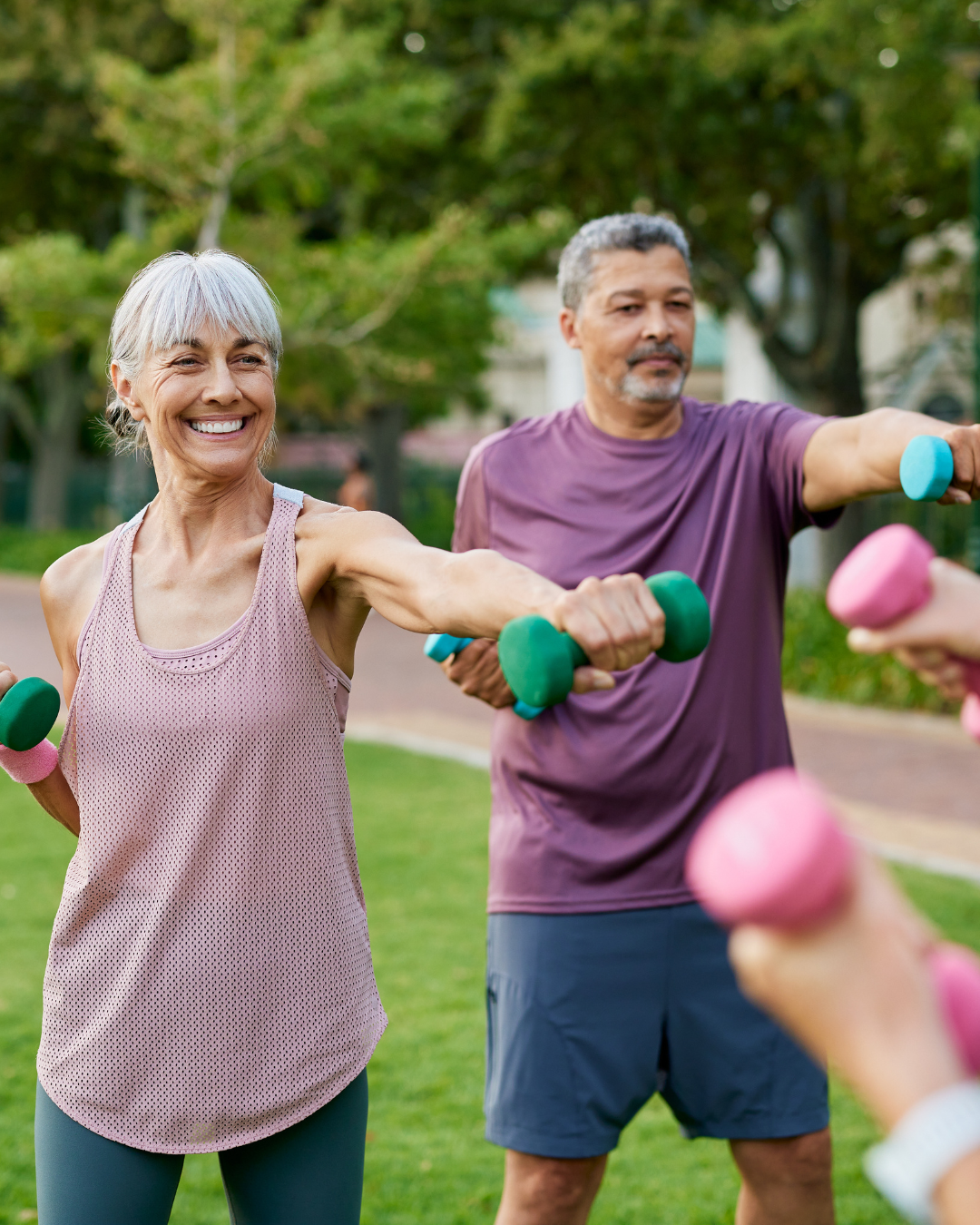
Stronger for Longer: The Surprising Benefits of Heavy Lifting in Older Adults
In today’s society we often search for solutions to problems instead of preventing these from actually appearing. Older age often comes with several aches and pains in the entire body oftentimes leading to people moving less. The “remedy” to this achiness, however, lies on the opposite end of the spectrum: movement, heavy strength training in particular. There are several studies showing clear evidence of the preventative benefits of strength training with heavy weights, especially in older adults. It also seems to be a cost-effective preventive / rehabilitative strategy at population level, which becomes more and more necessary with the increasing proportion of older adults in today's society. This month we want to break this somewhat intimidating topic down for you and provide an accessible and informed resource as different forms of movement are a key part of our project Active Aging and 4 Ways to Kick Post-Retirement Depression.
Before we dive deeper into the topic of strength training we first have to understand the physiological processes in the body as we age, focusing on muscle and bone function. Our muscle strength and rate of force development (RFD) as well as the power our muscle can produce decline [1]. Maintaining muscle function is however instrumental in maintaining independence and the ability to take care of daily tasks which require people to be mobile. On top of that bone density loss (osteoporosis), increased fracture risk as well as morbidity and mortality and decreased metabolic health further restrict older people in day to day activities. That’s where exercise, heavy weight strength training in particular, comes into play, as it is a powerful tool to counteract several of these critical physiological changes [2].
So now that we've gained a clear understanding of the physiological challenges we are dealing with in older age, let's try to define and explain the somewhat complex topic of heavy or high-load strength training. The question that will most certainly come up is: At which point do we consider it “heavy weight” strength training? It counts as heavy weight strength training when we train at 80% of our one-repetition maximum (1RM), and in very heavy strength training we train at 85% and more of our one repetition maximum. This also means that we aren’t doing very many repetitions, usually 3-5 [3]. It’s also very important to note that there is no one-size fits all approach and it is especially important to start and progress slowly and listen to your body’s cues (muscle soreness, joint pain, etc.) [4]. Especially in older adults, who already experience the effects of loss in muscle strength it is highly advisable to consult a professional and get a highly personalised program at the very beginning to reduce the chance of injuring themselves. There are several scientific studies on this topic with varying results, some claiming heavy strength training is most effective and others seeing an effect in both moderate and heavy weight strength training [5]. Either way doing any form of movement is better than none and you have to always find the thing that works for you in the long-term. At the bottom you can find an exemplary program, designed by one of OAC’s sport therapists.
As briefly mentioned before there is a great deal of Evidence on the topic of heavy strength training in older adults with studies focusing only on muscle development and others looking at the complete picture of physiological improvements as well as quality of life. Due to the huge collection of data in the field of heavy strength training we only want to give you a brief overview of the most significant scientific findings. A very recent systematic review [6], published at the end of 2024, focused on the effect of resistance training on bone mineral density (BMD) in older people (70+ years) suffering from sarcopenia (age-related loss of skeletal muscle mass, strength, and physical function). While improvements in BMD couldn't be seen, participants showed improvement in isometric strength (static force production), measured by the hand-grip test, as well as muscle strength, which could be seen in the chair stand test. Another systematic review from 2017 [7], focusing on the effects of exercise on muscle strength, body composition and physical functioning, found that long-term supervised strength training led to increased muscle mass and strength, as well as reduced abdominal fat.
In conclusion you can see that strength training, in several forms, presents to be a powerful but underrecognised tool to prevent and treat age related loss in muscle mass, power and function. Gaining muscle strength directly correlates with an increase in functional capacities, meaning older adults can maintain their independence in day-to-day life for longer. On a more practical note, it can be one of the best solutions to a pressing public health challenge because it can both serve as a preventive as well as rehabilitative measure. So get moving and power up those muscles to stay healthy, happy and independent!
Exercise Programme
General instructions
Warm up for 5 minutes (e.g. walking on the spot, shoulder circles)
6–10 repetitions of each exercise, 2–3 sets
Perform movements slowly (e.g. 3 seconds down, 2 seconds up)
Breathe calmly, do not strain
Have a chair or wall nearby for safety
1. Standing up and sitting down (chair squat)
Exercise sequence:
Stand in front of a stable chair. Slowly sit down without letting yourself fall, then stand up again in a controlled manner.
What to watch out for:
Weight on your heels
Knees pointing forwards
Back remains upright
Only use your hands for support if necessary
Trains: Legs, buttocks, functional strength for everyday life
2. Wall push-ups
Exercise sequence:
Lean against the wall with your arms outstretched. Bend your elbows and slowly lower your upper body towards the wall, then push yourself back up again.
What to watch out for:
Keep your body in a straight line
Tense your stomach slightly
Don't let your elbows stick out too far
Move slowly and in a controlled manner
Trains: Chest, shoulders, arms
3. Rowing with a towel (isometric)
Exercise sequence:
While sitting or standing, grasp a towel with both hands and pull it apart as if you were rowing. Hold the tension for 10–20 seconds.
What to watch out for:
Consciously pull your shoulder blades together.
Keep your neck relaxed.
Continue to breathe calmly.
Maximum tension without pain.
Trains: Back, posture, shoulder stability
4. Stair climbing or step-ups
Exercise sequence:
Alternately step onto a stair with one leg and step back down in a controlled manner.
What to watch out for:
Place your foot completely on the step
Keep your knees stable
Keep your upper body upright
Hold onto the handrail if necessary
Trains: legs, buttocks, balance
5. Wall sit
Exercise sequence:
Lean your back against the wall and move into a sitting position as if you were sitting on an invisible chair. Hold the position.
What to watch out for:
Knees bent at about 90 degrees
Back flat against the wall
Breathe evenly
Hold the position for 10–30 seconds
Trains: Thighs, muscular endurance
Progression (to make it ‘harder’)
Slower movement speed
Shorter breaks
Longer hold time (isometric)
Less support with your hands
References
1) Tøien T, Berg OK, Modena R, Brobakken MF, Wang E. Heavy Strength Training in Older Adults: Implications for Health, Disease and Physical Performance. J Cachexia Sarcopenia Muscle. 2025 Apr;16(2):e13804. doi: 10.1002/jcsm.13804. Erratum in: J Cachexia Sarcopenia Muscle. 2025 Aug;16(4):e70014. doi: 10.1002/jcsm.70014. PMID: 40241440; PMCID: PMC12003923.
2) Liberman K, Forti LN, Beyer I, Bautmans I. The effects of exercise on muscle strength, body composition, physical functioning and the inflammatory profile of older adults: a systematic review. Curr Opin Clin Nutr Metab Care. 2017 Jan;20(1):30-53. doi: 10.1097/MCO.0000000000000335. PMID: 27755209.
3) cf. 1)
4) Topp R, Mikesky A, Bawel K. Developing a strength training program for older adults: planning, programming, and potential outcomes. Rehabil Nurs. 1994 Sep-Oct;19(5):266-73, 297. doi: 10.1002/j.2048-7940.1994.tb00820.x. PMID: 7855390.
5) Kalapotharakos VI, Michalopoulos M, Tokmakidis SP, Godolias G, Gourgoulis V. Effects of a heavy and a moderate resistance training on functional performance in older adults. J Strength Cond Res. 2005 Aug;19(3):652-7. doi: 10.1519/15284.1. PMID: 16095421.
6) Peng D, Zhang Y, Wang L, Zhang S. Effects of over 10 weeks of resistance training on muscle and bone mineral density in older people with sarcopenia over 70 years old: A systematic review and meta-analysis of randomized controlled trials. Geriatr Nurs. 2024 Nov-Dec;60:304-315. doi: 10.1016/j.gerinurse.2024.09.016. Epub 2024 Oct 4. PMID: 39368450.
7) cf. 2)
Author: Lea Laciak, Outdoor Against Cancer
Exercise Programme by Hannah Pfeifle, Outdoor Against Cancer